

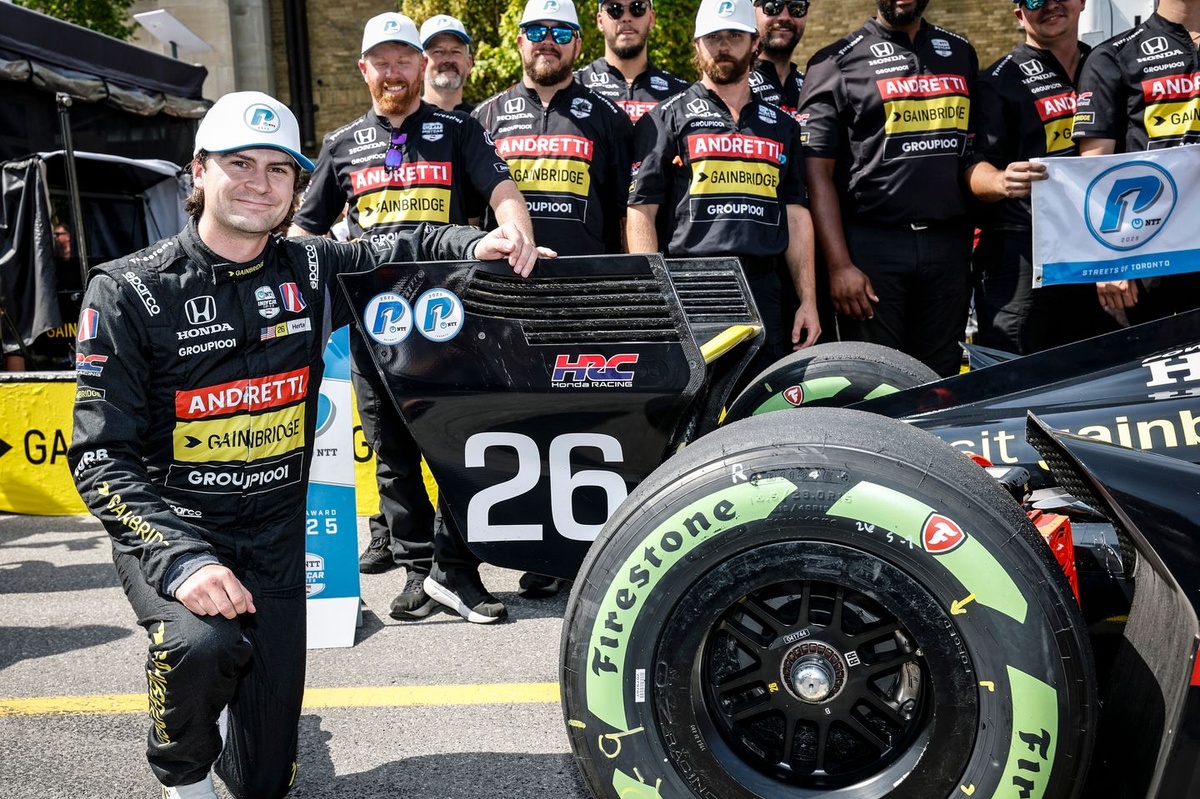
The transition of Colton Herta from a marquee name in the NTT IndyCar Series to a competitor in Formula 2 (F2) is a maneuver virtually unheard of in high-level motorsports. At 25 years old, Herta is not a rookie seeking promotion; he is an established winner—the youngest in IndyCar history—who has purposefully taken a step backward to force an entry into Formula 1. This audacious plan, fueled by the desire to drive for the prospective Cadillac F1 team, places an immense burden not just on Herta’s career, but on the global credibility of the entire IndyCar Series.
The Super License Hurdle: Trading Wins for Points
Herta’s departure from the pinnacle of North American open-wheel racing, where he secured nine victories and finished second in the 2024 championship, was not driven by a lack of talent, but a lack of paperwork. Specifically, the bureaucratic barrier known as the FIA Super License points system. While Herta possesses the speed required for F1, regulatory constraints currently deny him the necessary credential.
To bypass this technicality, Herta and his backers—TWG Motorsports, the parent company of the aspiring Cadillac F1 team—engineered a controversial but necessary strategy: Spend the 2026 season in F2 with the Hitech TGR team. A strong performance in F2, considered the primary feeder series for F1, would guarantee the required Super License points, effectively unlocking the F1 grid for Herta.
For veterans like 1978 F1 world champion Mario Andretti, the move is a testament to commitment rather than failure.
“It’s now or never, and he knows that, and he’s willing to take that chance,” Andretti noted. “That is a beautiful commitment I would support 3,000 percent, to go one step down to go two steps forward.”
The Technical Culture Shock: Hard Racing vs. Tire Management
In theory, a driver of Herta’s caliber should immediately dominate the F2 grid, which is typically filled with rising talents still honing their craft. However, the initial three-day postseason test in Abu Dhabi revealed the profound technical disparity between the two series. Herta found himself only 14th fastest in one session and 19th in another, a clear signal that adaptation will be anything but immediate.
The core difference lies in the tire philosophy. IndyCar utilizes robust Firestone rubber designed for hard, consistent racing and aggressive driving over long stints. F2, using Pirelli tires, demands a diametrically opposed approach—intense management, fragility, and a pursuit of single-lap perfection.
Max Esterson, one of the few Americans recently navigating F2, highlighted this challenge, explaining that useful high-speed running is severely limited in F2 sessions. The qualifying routine, in particular, is a stressful ballet of extreme caution followed by one explosive push lap.
“The out lap and warmup lap are very structured and very slow; you’re not actually driving at speed,” Esterson described. “You have to be careful not to damage the surface. Qualifying is hard to explain because you basically troll around, and then you arrive in Turn 1 at 200 miles an hour and have to nail it with the one good lap you have… It’s perfection with very little preparation.”
For Herta, accustomed to the brutal, continuous pace of an IndyCar race, mastering the F2 discipline of delicate tire preservation—a skill often viewed by IndyCar purists with a dash of technical irony—will be the defining factor of his season.
IndyCar’s Global Litmus Test
The true stakes of Herta’s F2 season extend far beyond his personal career trajectory. He has become an inadvertent ambassador for IndyCar’s quality of competition. His performance will be dissected by international motorsport commentators, serving as a direct measuring stick against the European feeder system.
Pato O’Ward, Herta’s former teammate and a driver with F1 testing experience himself, keenly understands the pressure.
“I want him to do well,” O’Ward stated, acknowledging the personal and professional risks involved. “If it doesn’t go well, there’s always going to be those guys that hook to that and use that as rage bait. So that’s the reality.”
If Herta struggles, critics of North American open-wheel racing will quickly argue that the IndyCar talent pool is not globally competitive. Conversely, if he dominates, it will validate the stature of the IndyCar Series, proving that its champions are ready for F1, despite the lack of direct licensing pathways.
Herta’s unique career detour is not merely a job change; it is a high-stakes proof-of-concept. He must quickly shed eight years of conditioning, adapt to a radically different vehicle and tire dynamic, and defeat a field of young drivers who have been training specifically for this singular format. His success is not just a personal triumph, but a desperately needed win for the international reputation of the series he left behind.
 Torin Vale