

The dust has barely settled on the thrilling conclusion of the 2025 championship—a campaign that saw a title fight extend to the final kilometers—yet the industry clock has already reset. We stand on the precipice of Formula 1`s most significant regulatory shift in a generation. The 2026 season is not merely an incremental update; it is a profound technical rebirth, complete with new power unit architectures, revised aerodynamic philosophies, and an expanded, fiercely contested grid.
The Crux of the Change: New Power Unit Architecture
For the engineering teams scattered across the globe, the short winter hiatus has been anything but restful. The primary focus of the 2026 overhaul is the mandated change to the power unit (PU) regulations. While the V6 combustion engine remains, the MGU-H component—a technically masterful but often prohibitively expensive piece of machinery—has been eliminated. In its place, the electrical power output sees a dramatic increase, shifting the balance of performance decisively toward sustainable energy recovery and deployment.
The technical mandate is clear: simplify the engines, standardize some components to control costs, and make the formula appealing to new manufacturers. This reset serves as the great equalizer, theoretically wiping clean any residual advantage accumulated under the previous cycle. It promises an exciting—or perhaps terrifying, depending on your team principal’s perspective—opportunity for significant performance differentials early in the season. Teams that master the integration of the new electrical boost systems stand to gain immediate dividends.
The Grid Expands: Cadillac and Audi Enter the Fray
The competitive landscape of Formula 1 is set to broaden with the official expansion of the grid to 11 teams and 22 drivers. This influx of manufacturers and capital is a clear indicator of the sport’s burgeoning global health.
- Audi’s Official Arrival: Having acquired the Sauber team, Audi now transitions from engine supplier commitment to full factory works entry. Their investment and established engineering pedigree suggest they aim to be competitive immediately, leveraging the regulatory shift to establish a front-running position.
- The Cadillac Contingency: The long-anticipated entry of Cadillac (under the Andretti Global banner) solidifies the sport`s presence in the critical American market. Adding an 11th team introduces a new dynamic, intensifying competition for points and track position. More cars means more variables, and historically, more variables lead to better racing.
The Initial Readout: Preseason Testing Schedule
Before the lights go out in Melbourne, the new machines must undergo rigorous evaluation. For fans eager for the first glimpse of the 2026 pecking order, testing is the prologue to the season.
The structure for 2026 testing is strategically split: four days of private, clandestine running in Barcelona followed by six televised days in Bahrain. The Barcelona session is strictly for operational shakedowns and initial correlation checks. No public times, no broadcasting. It is the highly secretive pre-game where teams quietly manufacture their initial rumors and excuses for later poor performance.
All focus then shifts to the Middle East, where the true data is harvested:
Official F1 Preseason Testing (Bahrain)
- Session 1: February 11–13, Bahrain International Circuit
- Session 2: February 18–20, Bahrain International Circuit
Six days in Sakhir offer the first opportunity for the new-era cars to run full race simulations and set competitive public lap times. This period will be invaluable for establishing reliability—a critical factor given the PU complexity—before the season opener.
The 24-Round Global Campaign
The 2026 calendar maintains the ambitious schedule of 24 Grands Prix, demanding exceptional logistical efficiency and driver endurance across ten months. The championship journey begins in the Antipodes and circumnavigates the globe before concluding under the lights in Abu Dhabi.
Notable calendar highlights include:
- The Triple Crown of America: The United States solidifies its status as a core market, hosting three events: Miami (May 1-3), Austin (Oct. 23-25), and the late-season spectacle in Las Vegas (Nov. 19-21).
- Madrid’s Debut: In a significant shift for European racing, the Spanish Grand Prix relocates from Barcelona-Catalunya to a new, dynamic circuit in Madrid, scheduled for September 12-14.
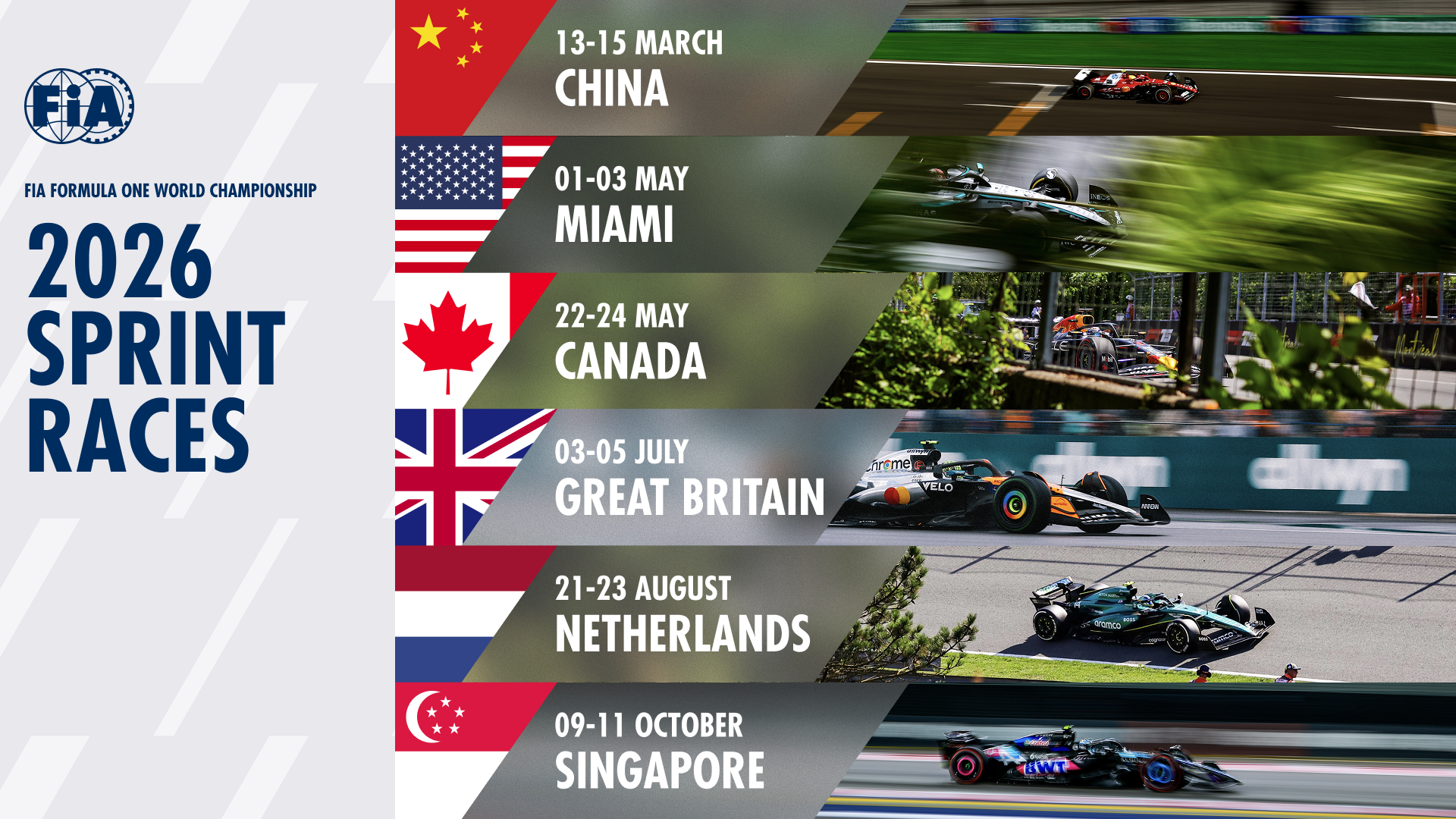
- Six Sprint Weekends: The controversial but exciting format returns, featuring sprint races in strategic locations including Shanghai, Miami, Montreal, Silverstone, Zandvoort, and Singapore, injecting crucial extra points into the championship fight.
Formula 1 2026 Complete Race Schedule
| Round | Dates | Grand Prix | Format |
|---|---|---|---|
| 1 | Mar 6–8 | Australia (Melbourne) | Standard |
| 2 | Mar 13–15 | China (Shanghai) | SPRINT |
| 3 | Mar 27–29 | Japan (Suzuka) | Standard |
| 4 | Apr 10–12 | Bahrain (Sakhir) | Standard |
| 5 | Apr 17–19 | Saudi Arabia (Jeddah) | Standard |
| 6 | May 1–3 | Miami (USA) | SPRINT |
| 7 | May 22–24 | Canada (Montreal) | SPRINT |
| 8 | Jun 5–7 | Monaco (Monaco) | Standard |
| 9 | Jun 12–14 | Spain (Barcelona) | Standard |
| 10 | Jun 26–28 | Austria (Spielberg) | Standard |
| 11 | Jul 3–5 | Great Britain (Silverstone) | SPRINT |
| 12 | Jul 17–19 | Belgium (Spa) | Standard |
| 13 | Jul 24–26 | Hungary (Budapest) | Standard |
| — F1 SUMMER BREAK — | |||
| 14 | Aug 21–23 | Netherlands (Zandvoort) | SPRINT |
| 15 | Sep 4–6 | Italy (Monza) | Standard |
| 16 | Sep 12–14 | Spain (Madrid — New) | Standard |
| 17 | Sep 24–26 | Azerbaijan (Baku)* | Standard |
| 18 | Oct 9–11 | Singapore (Marina Bay) | SPRINT |
| 19 | Oct 23–25 | United States (Austin, Texas) | Standard |
| 20 | Oct 30–Nov 1 | Mexico City (Mexico) | Standard |
| 21 | Nov 6–8 | São Paulo (Brazil) | Standard |
| 22 | Nov 19–21 | Las Vegas (USA) | Standard |
| 23 | Nov 27–29 | Qatar (Lusail) | Standard |
| 24 | Dec 4–6 | Abu Dhabi (Yas Marina) | Standard |
*Note: The Azerbaijan Grand Prix is scheduled for a Saturday race day.
Conclusion: Anticipating the Unpredictable
The 2026 Formula 1 season is poised to be an inflection point in the sport’s modern history. The combination of radical technical change, the arrival of powerful new factory teams (Audi) and established brands (Cadillac), and a demanding 24-race schedule guarantees an element of volatility. Historically, major regulatory shifts destabilize the established hierarchy. The question is not if the pecking order will change, but by how much. For the engineering departments, the new era demands rapid adaptation; for the drivers, it requires mastery of radically new machinery; and for the fans, it promises a season defined by technological intrigue and unpredictable outcomes.
 Gideon Holt
  Torin Vale